



Research
Click here for a short video on the research being carried out in the Gunjan lab
RESEARCH INTERESTS IN BASIC SCIENCES ( scroll down for our preclinical and translational research )
In eukaryotes, the genomic material in the form of DNA is packaged with the help of highly basic histone proteins into a nucleoprotein structure called chromatin. Histones are primarily synthesized in S-phase and deposited by histone chaperones on to the replicating DNA to form chromatin in a process known as chromatin assembly [1]. Subtle defects in chromatin assembly or changes in histone levels affect chromosome stability, DNA damage sensitivity and viability of cells [2, 3, 4]. Hence, the assembly of a proper chromatin structure is vital for preventing genomic instability, a hallmark of human cancer cells. The long-term goal of our laboratory is to understand how histones and chromatin structure contribute to the maintenance of genomic stability in the presence and absence of DNA damage. Our initial efforts are directed mainly towards the study of chromatin dynamics in the context of DNA damage and repair. Until recently, most mechanistic studies in the field of DNA repair were performed in vitro using naked DNA templates. These studies have generated a wealth of data [5], but very little attention has been paid to the fact that in eukaryotes these processes occur on chromatin in vivo. Despite considerable progress in studies of DNA repair in the context of chromatin [6], our understanding of chromatin dynamics during DNA repair is far from complete. Using a variety of in vivo and some in vitro approaches in budding yeast and mammalian cells, we are focusing on how DNA lesions caused by different kinds of DNA damaging agents affect chromatin structure, and how these lesions are recognized and repaired in the context of chromatin. Does efficient recognition and repair of different kinds of DNA lesions in chromatin require localized or extensive disruption of chromatin to allow access to the repair machinery? If so, how is the chromatin structure restored once the lesion has been repaired? How are epigenetic marks (acetylation, methylation, etc.) on the histones maintained at sites of DNA damage? What are the factors involved in the chromatin disassembly/assembly during DNA damage and repair? Since histone synthesis is largely restricted to S-phase, is passage through S-phase required for the re-establishment of proper chromatin structure at the site of damage? Using a combination of tools from biochemistry, molecular biology and cell biology, including advanced live cell microscopy techniques (see examples provided below), these are only a few of the innumerable unanswered questions that we hope to address in our laboratory.
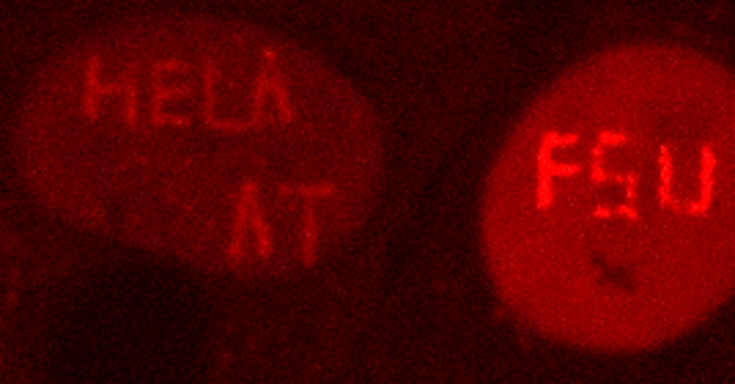
Recruitment of PCNA to the sites of laser microirradiation induced DNA damage in live human HeLa cells.
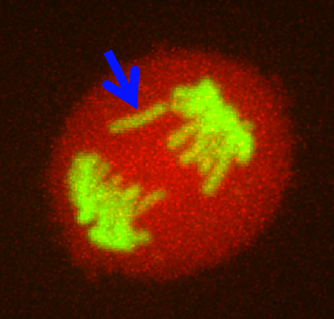
Lagging chromosome during anaphase in a CHO cell.
Current basic research projects
Why do eukaryotic cells have multiple copies of histone genes ? Budding yeast has two copies of each core histone gene and only one copy is required for survival [8]. In fact, deletion of any one of the two gene pairs encoding histones H3 and H4 does not result in an obvious phenotype [7, 8]. So why have eukaryotes evolved with multiple copies of histone genes? It is possible that the different copies of genes encoding the same protein perform overlapping as well as some unique functions. We are trying to evaluate this hypothesis by investigating the rDNA chromatin in yeast cells lacking one or the other copy of the gene pair encoding histones H3 and H4.
Investigating post-translational control of histone protein levels in mammalian cells : All eukaryotic cells, especially mammalian cells with their multiple copies of histone genes, are likely to face constant problems due to excess histones and may have evolved a pathway for dealing with them. We are particularly interested in finding out if CHEK2 (the mammalian homolog of budding yeast Rad53) dependent or independent pathway exists in mammalian cells for regulating histone protein levels [3]. We are using a combination of CHEK2 knockout cell lines and shRNA-based gene knockdown strategies for our studies.
RESEARCH INTERESTS PRECLINICAL AND TRANSLATIONAL SCIENCES
In recent years, our lab has pivoted towards leveraging its findings from basic research, and its expertise in the areas of genomic stability, epigenetic mechanisms, and gene regulation, to develop therapeutic strategies for specific human diseases, primarily those that are characterized by aberrant cell proliferation or driven by fibrotic processes. Currently, it can take several decades to develop, test and obtain US Food and Drug Administration (FDA) approval for a new drug for use in human patients. To ensure rapid clinical impact, our approach is to identify and repurpose appropriate drugs from the list of over 3,000 small molecule drugs that are already FDA approved for use in human patients for specific conditions. Our efforts have already resulted in multiple patent applications for therapeutic or diagnostic strategies for different human health conditions and the list is growing steadily ( https://patents.justia.com/inventor/akash-gunjan ).
Current preclinical and translational projects
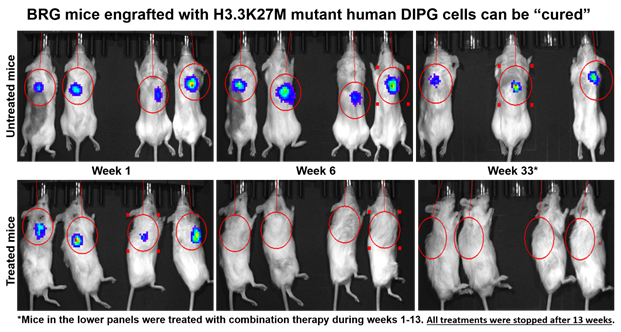
Developing therapies for childhood brain cancers carrying histone H3 mutations : Brain tumors are the leading cause of cancer-related deaths in children and gliomas are the most common type of brain tumor. Specific mutations in histone H3, especially the H3.3 variant, drive the currently untreatable and 100% fatal childhood gliomas known as pediatric High-Grade Gliomas (pHGG), including the Diffuse Midline Gliomas (DMG) such as Diffuse Intrinsic Pontine Gliomas (DIPG) that carry the H3K27M mutation and occur in the brain stem [9]. Because the brain stem controls basic body functions including breathing and heart rate, surgical removal of DIPG tumors is impossible, and known chemotherapeutics do not work. DIPG’s median age for diagnosis is 6-7 years, and the median survival time is about 11 months following diagnosis. Hence, DIPG is currently a heartbreaking and devastating cancer for patients and their families and is in desperate need for effective therapies. We and others have identified multiple molecular pathways in H3 mutant cancer cells that appear to make independent contributions to driving these cancers [10]. Remarkably, these molecular pathways can be specifically blocked using existing brain penetrant FDA approved agents, leading to the targeted elimination of the mutant cancer cells, while sparing normal cells. We are currently testing these therapeutic strategies in mouse xenograft models, and our initial data suggest that some of our therapies may be potentially curative as shown below (also see https://med.fsu.edu/iprd/pediatric-high-grade-glioma ).
Combination therapies for Homologous Recombination Deficient (HRD) adult cancers : Our DNA is constantly being damaged by environmental agents like radiation and normal processes in our cells. Cells either fix the DNA damage or, if it is too severe, the cell will deliberately die to avoid passing on harmful changes that can lead to cancer. The most dangerous type of DNA damage is when both strands of the DNA are broken at the same place. The cell has two ways to fix this: an accurate method called homologous recombination (HR), and three error-prone ways called non-homologous end joining (NHEJ). HR depends on over two dozen genes such as BRCA1 and BRCA2. When these genes are faulty, cells rendered HR deficient (HRD) and must rely on inaccurate NHEJ repair, which in turn causes genomic instability and mutations to build up rapidly, eventually leading to cancer. Up to 30% of breast cancers, 10% of prostate, 35% of pancreatic and 50% of ovarian cancers are HRD and these often have the worst outcomes [11]. Using patient derived cells, organoids and mouse xenograft models, we are testing whether blocking multiple NHEJ pathways at the same time will be an effective and safe therapeutic approach for these cancers.
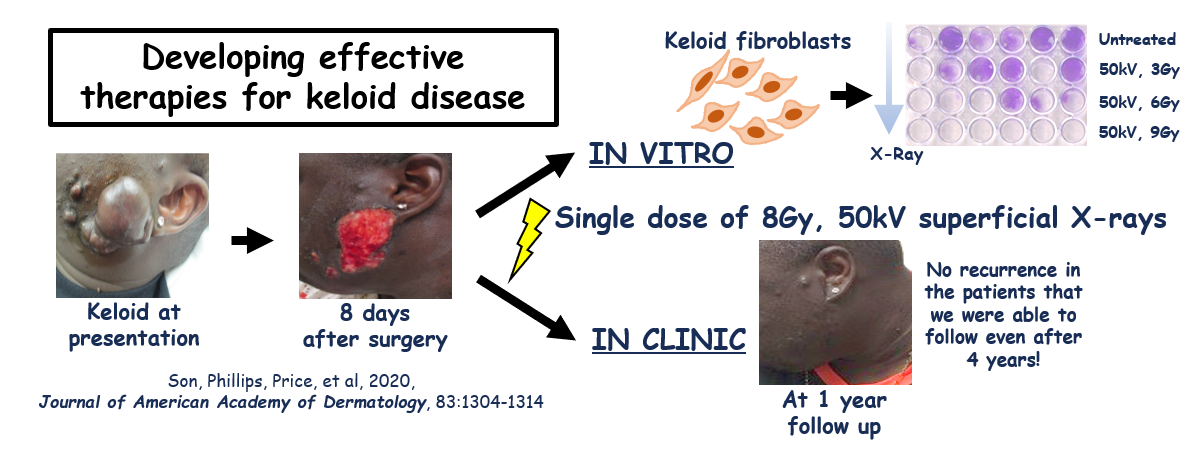
Molecular determinants of keloid formation and therapy : Keloids are non-cancerous fibrotic skin tumors that are often large, painful and disfiguring. They occur in susceptible individuals due to abnormal wound healing and exhibit excessive fibroblast proliferation and collagen deposition. Keloids occur at very high rates among dark-skinned individuals compared to lighter-skinned people, suggesting that genetic and/or epigenetic factors strongly contribute to keloid disease. However, the molecular mechanisms involved in keloid formation in susceptible individuals are unknown. Small keloids are typically treated using corticosteroid injections, but a significant percentage of patients do not respond to it. Larger keloids are usually treated by surgical removal, following which they regrow in nearly 100% of the cases in the absence of any adjuvant therapy and are even more difficult to treat following recurrence. Our early studies established that a single low dose of skin-deep radiation can prevent keloid recurrence after surgery [12; also see image shown below]. Now, using genomic sequencing-based approaches on patient derived keloid and normal tissues or cells to identify differences in their genetic/epigenetic and gene expression profiles, we are trying to uncover the molecular determinants of keloid susceptibility, response to existing therapies, as well as devising new therapeutic strategies for keloids. We are also using Machine Learning tools on patient datasets to identify new ways to predict patient response to existing keloid therapies [13].
Developing repurposed therapies for lung fibrosis : Pulmonary fibrosis, is a progressive and often fatal lung disease characterized by aberrant fibroblast proliferation and excessive extracellular matrix (ECM) deposition, leading to irreversible conversion of normal lung tissue to fibrotic tissue [14]. About a quarter million Americans live with the condition at any given time, with 50,000 new cases and 40,000 deaths recorded each year. Currently, approved mono- and combination therapies may slow the decline in lung function at best but do not reverse established fibrosis, and there is a critical need for more effective therapies. We are currently applying the knowledge gained from developing therapies for fibrotic keloids to develop repurposed combination therapeutics for lung fibrosis. If successful, we hope to expand these strategies to treat additional fibrotic diseases.
References
- Verreault, A. (2000). De novo nucleosome assembly: new pieces in an old puzzle. Genes & Development,14: 1430-1438.
- Gunjan, A., Paik, J., and Verreault, A. (2005). Regulation of Histone Synthesis and Nucleosome Assembly. Biochimie, 87: 625-635.
- Gunjan, A., and Verreault, A. (2003). A Rad53 kinase-dependent surveillance mechanism that regulates histone protein levels in Saccharomyces cerevisiae. Cell, 115: 537-549.
- Singh, R.K., Miquel Kabbaj, M.-H., Paik, J., and Gunjan, A. (2009). Histone levels are regulated by phosphorylation and ubiquitylation dependent proteolysis. Nature Cell Biology, 11: 925-933.
- Lowndes, N.F., and Murguia, J.R. (2000). Sensing and responding to DNA damage. Current Opinion in Genetics and Development,10: 17-25.
- Green, C.M., and Almouzni, G. (2002). When repair meets chromatin. EMBO Reports, 3: 28-33.
- Cross, S.L., and Smith, M.M. (1988). Comparison of the structure and cell cycle expression of mRNAs encoded by two histone H3-H4 loci in Saccharomyces cerevisiae. Molecular and Cellular Biology, 8: 945-954.
-
Liang, D., Burkhart, S.L., Miquel Kabbaj, M.-H., and Gunjan, A. (2012). Histone gene dosage regulates DNA damage sensitivity in a checkpoint-independent manner by the homologous recombination pathway. Nucleic Acids Research,40: 9604-9620.
-
Schwartzentruber, J., Korshunov, A., Liu, X.Y., Jones, D.T., Pfaff, E., Jacob, K., Sturm, D., Fontebasso, A.M., Quang, D.A., Tonjes, M., et al. (2012). Driver mutations in histone H3.3 and chromatin remodelling genes in paediatric glioblastoma. Nature, 482: 226-231.
-
Phillips, E., Menz, S.L., Giovinazzi, S., Hagemeyer, C., Kanga, K.J.W., Zamani, N., Muti, S.C., Singh, R.K., Canzani, D., Kabbaj, Marie-Helene M., Davidson, M.W., and Gunjan, A. Histone variant H3.3 plays an evolutionarily conserved role in DNA repair that can be targeted for cancer therapy. The EMBO Journal . UNDER REVISON.
-
Mekonnen, N., Yang, H., and Shin, Y.K. (2022). Homologous Recombination Deficiency in Ovarian, Breast, Colorectal, Pancreatic, Non-Small Cell Lung and Prostate Cancers, and the Mechanisms of Resistance to PARP Inhibitors. Frontiers in Oncology, 12: 880643.
-
* Son, Y., * Phillips, E., Magrini, K., Rosenberg, L., Stefanovic, B., Wolfe, C., Shaath, T., Om, A., Cohen, G., and Gunjan, A. (2020). Treatment of keloids with a single dose of low energy superficial X-ray radiation to prevent recurrence after surgical excision: an in vitro and in vivo study . Journal of American Academy of Dermatology, 83:1304-1314. *Equal contribution.
-
Zamani, N., Akbari, P., Zamani, M., Rodriguez, C.A., Tirgan M.H., and Gunjan, A. Leveraging machine learning and clinical data to predict response to intralesional corticosteroids in keloid patients. Journal of American Academy of Dermatology. UNDER REVISION. (Medrxiv: https://doi.org/10.1101/2025.05.05.25326913 )
-
Raghu G, Remy-Jardin M, Myers JL, et al. Diagnosis of idiopathic pulmonary fibrosis. An official ATS/ERS/JRS/ALAT clinical practice guideline. American Journal of Respiratory and Critical Care Medicine. 2018; 198(5): e44-e68.