


Our Campuses at a Glance
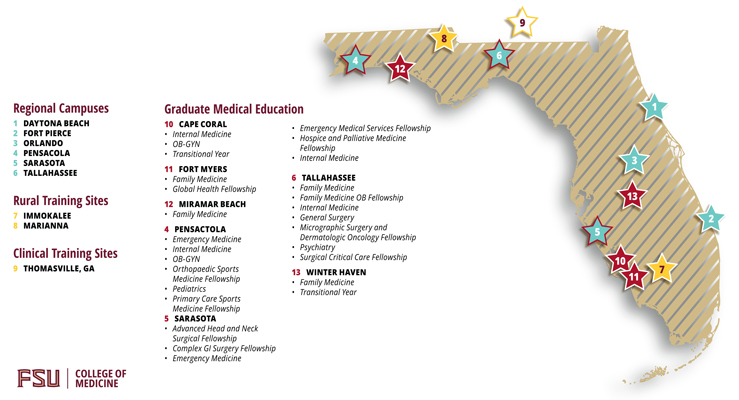
If you ask the deans of the College of Medicine’s regional campuses why this new model for medical education has worked so well, they’ll all say the same thing: the faculty.
It was a novel idea: have practicing physicians at our six regional campuses and three rural training sites take on third- and fourth-year students almost as apprentices at their offices, clinics and other venues, giving them the one-on-one wisdom and hands-on opportunities they wouldn’t get at a large academic medical center. The only catch, of course, was whether these physicians would have the time.
Amazingly, as of 2026, nearly 3,600 have found the time. More important, they have become excellent teachers during students’ required rotations in family medicine, internal medicine, pediatrics, surgery, obstetrics-gynecology, geriatrics, psychiatry and emergency medicine, plus electives. Thanks to them and to the clerkship directors, College of Medicine students have excelled on national exams of clinical knowledge and skills. And for their part, the faculty members say that teaching not only makes them sharper physicians but also rejuvenates their enthusiasm for practicing medicine.
In addition to our regional campuses, the college's Graduate Medical Education program is addressing Florida's physician workforce shortage head on. According to the Florida Department of Health’s 2025
Physician Workforce Annual Report
, 66 of the state’s 67 counties have documented primary care physician shortages. Additional studies commissioned by the Florida Hospital Association and others estimate the state will be facing a deficit of up to 22,000 physicians by 2030-2035.
Addressing that urgency is where the FSU College of Medicine’s Graduate Medical Education program steps in, training tomorrow’s healthcare professionals today.
Over the past four years (2022-2026), the College of Medicine’s GME programs have grown from 161 slots to train resident physicians and fellows to 516. Meanwhile, it has nearly doubled its healthcare partner affiliations where physicians train, from five to nine. Studies show that physicians tend to stay in the region where they complete their residencies. Of this year’s FSU GME graduates, 54% will stay in Florida.
Additionally, the college's Physician Assistant Program
has more than 370 graduates, each playing a vital role in the healthcare team.
The links below will take you to specific information about each of our regional campuses, including lists of those all-important faculty members mentioned above.
Regional Campuses
Rural Training Sites
The FSU College of Medicine also has a training site in Thomasville, Georgia.